Article: The Fibre That Adds Up
This article was originally published via LinkedIn. Click here to view the article.
By Martin Kaderavek, Founder & CEO, Pectin 360
In my previous article, I asked why Australia's fibre gap keeps widening while the market for fibre ingredients grows. In this article, I focus on what we're doing to close this gap.
Over the past twelve months, under Pectin 360's CRC-P Round 17 federal government grant program supporting funds ($2.1m), with industry partners Scimita Group, RMIT University, DöhlerGroup, Ahurei and Hank's Jam, we've been running larger scale trials on two feedstocks most people think of as waste: Australian citrus peel & apple pomace - the fibrous residue left after juice and pectin extraction.
The result is two provisional dietary fibre specifications - one from citrus, one from apple - both clean-label, non-GMO, gluten-free, suitable for vegan and vegetarian diets and free of E-numbers on the label. Both are designed for the same core jobs food manufacturers need: texturising, stabilising and fibre-enrichment, in human food and companion animal food alike.
Here's the part we think is genuinely interesting... Depending on how much pectin we leave in the fibre during processing, we can produce either a functional fibre for texturising and stabilising, or a higher-viscosity, gelling fibre with prebiotic potential. Combined with our own pectin, that makes Pectin 360 a genuine one-stop shop: functional fibres and pectins, tailored to the job, from a single Australian feedstock.
That flexibility matters because it means we're not just replacing an imported commodity with a local one. We're offering formulators a choice they don't currently have, from a single, traceable Australian source.
We’ve also been putting the fibre through its paces on taste and texture, with comprehensive organoleptic testing conducted. And on the numbers, our fibre’s water and oil binding capacity consistently matches or betters the commercial benchmarks we tested it against, across both our citrus and apple lines.
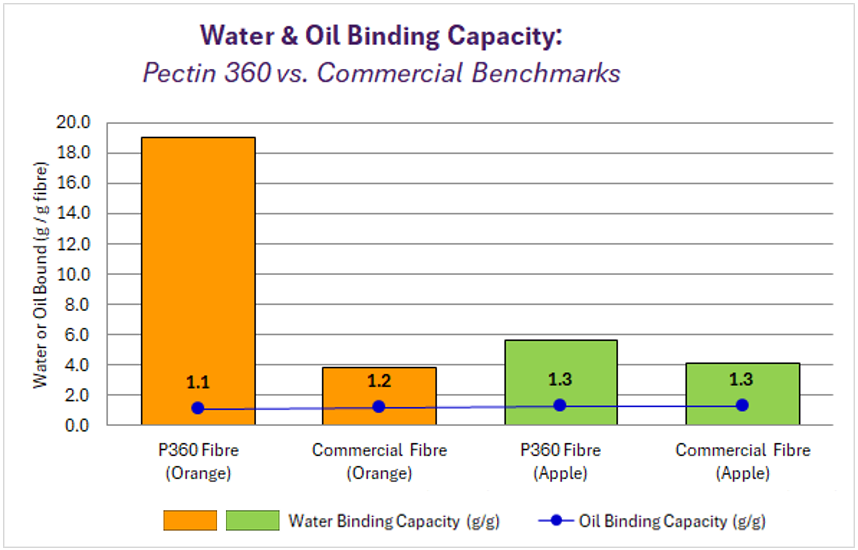
Figure 1: Water & oil binding capacity: Pectin 360 vs. commercial benchmarks.
None of this is just scientific curiosity. An independent techno-economic feasibility study has validated the commercial-scale plant (engineering-grade process simulation, robust CapEx and OpEx). This definitively confirms that producing pectin and fibre together makes a materially stronger business case than either product alone. More on this techno-economic feasibility study in a later article.
We've now designed our pilot plant and are securing the investment needed to complete construction and commissioning. Our next milestone is producing representative pectin and fibre samples at pilot scale for customer validation trials. We'd like to hear from organisations who want to be among the first to evaluate such samples. If you formulate with fibre or pectin, or distribute functional ingredients, and want early access to Australian-made, waste-derived alternatives to what you're currently importing, we'd welcome a conversation.
The gap I described in Part 1 isn't going to close on its own. What we are doing is aiming to close this gap in a highly effective way, using Australian strengths.
Interested in sampling our citrus or apple fibre, or our pectin, once pilot production is underway? Or interested in supporting our growth pathway? Please get in touch - martin.kaderavek@pectin360.com.au.