
Article: Building Resilience in a Volatile Global Supply Chain
This article was originally published via LinkedIn. Click here to view the article.
Building Resilience in a Volatile Global Supply Chain - What It Means for Australian Food Manufacturing
By Martin Kaderavek, Founder & CEO, Pectin 360
The era of predictable, low-cost global supply chains is over. Not temporarily - structurally.
In the past 30 days alone, the world has witnessed the effective closure of the Strait of Hormuz following US and Israeli strikes on Iran, the simultaneous resumption of Houthi attacks on Red Sea shipping and Brent crude surging past $100 / barrel for the first time in four years. For the first time in modern history, both Middle East's critical maritime corridors are simultaneously disrupted.
For Australian food manufacturers, this is not a distant geopolitical story. It lands directly on your input costs, your lead times and your ability to guarantee supply.
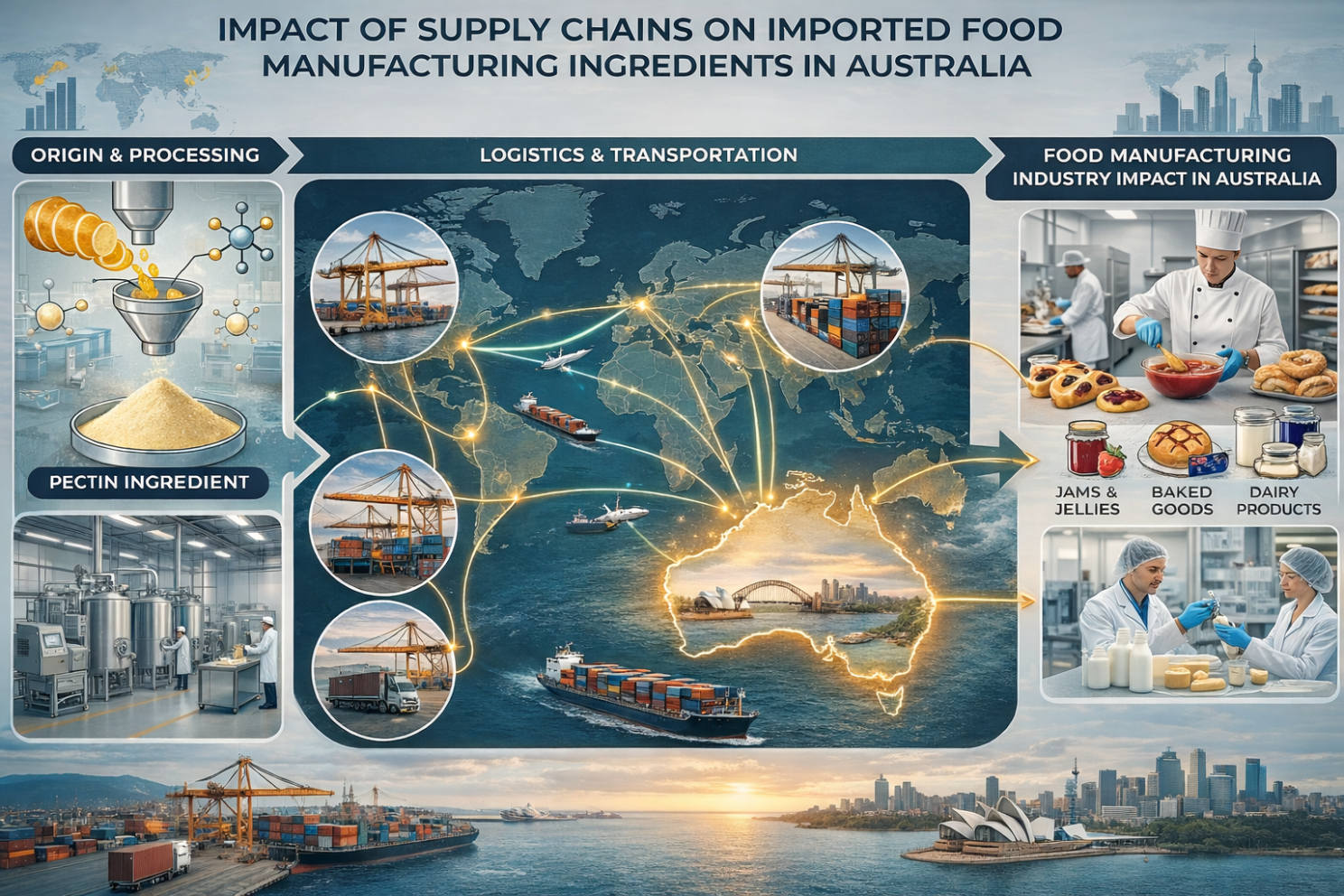
Impact of supply chains on imported food manufacturing ingredients in Australia.
The Numbers & Trends Tell the Story
The Australian Industry Group's most recent data shows 47% of Australian industrials are now experiencing active supply chain disruptions, up from 35% in late 2024. That recovery from the pandemic-era peak of 79% took nearly three years. The Hormuz crisis, compounded by US tariff effects still working through global supply chains, threatens to reverse much of that progress within months. The AI Group was explicit - surveyed just four months after the initial US tariff announcements, they noted the disruption rate "is very likely to continue to rise."
At the global level, the NY Fed's Global Supply Chain Pressure Index — the benchmark used by central banks and logistics operators worldwide - was already trending upward alarmingly. The Hormuz closure hadn't yet registered in that reading.
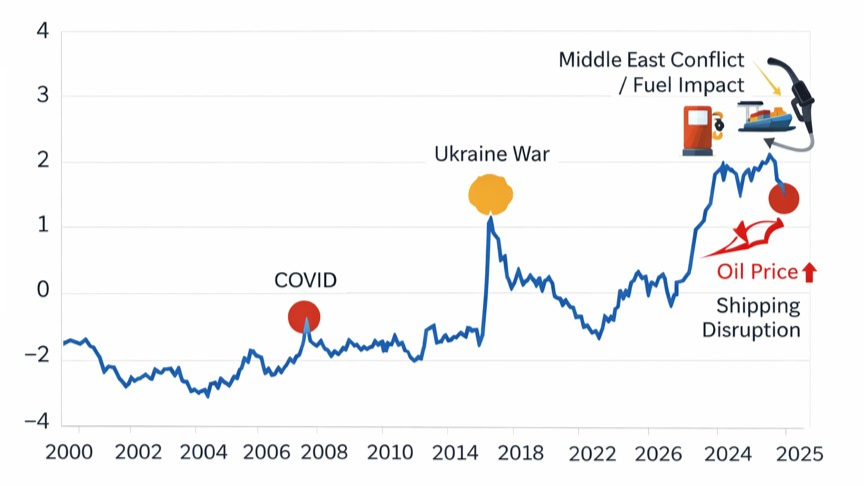
Global Supply Chain Pressure Index. Federal Reserve Bank of New York, GSCPI, December 2025.
Container shipping rates on Asia–Europe routes peaked at over $8,400 per FEU (forty-foot equivalent containers) in mid-2024 during the Red Sea crisis alone. Suez Canal transits collapsed by more than 90% between December 2023 and March 2024 and remain ~70% below pre-crisis levels heading into 2026. These are not temporary spikes. They represent a fundamental repricing of global maritime risk, and the Hormuz closure compounds every one of those pressures simultaneously.
The Ingredient-Specific Problem
Layered on top of the shipping and energy shock is a structural supply-side crisis specific to citrus-derived ingredients.
Citrus Greening Disease, Huanglongbing, has materially reduced citrus production across major global growing regions. It doesn't just reduce yield; it degrades fruit quality in ways that affect the extraction efficiency of functional ingredients like pectin. Combined with freight cost surges and shipping volatility, the result is tightening supply and escalating price volatility for one of food manufacturing's most widely used hydrocolloids.
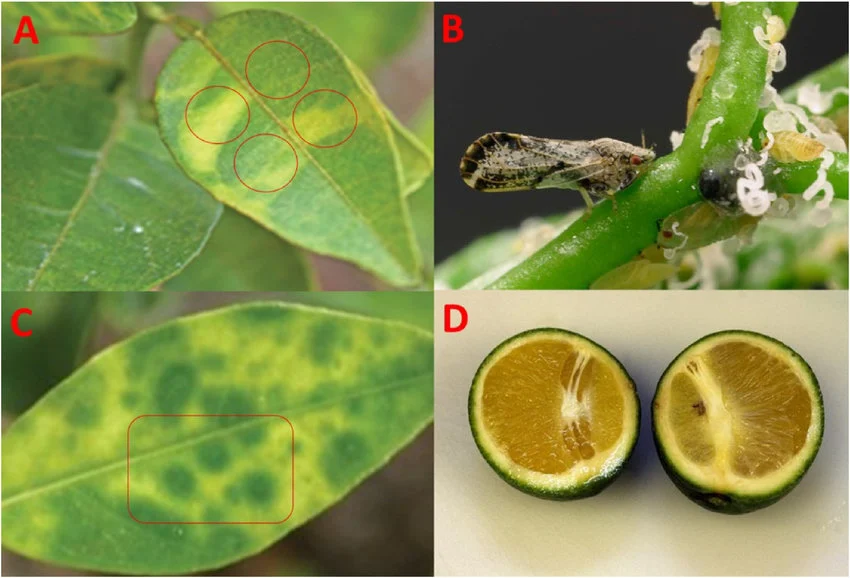
Identification of citrus greening based on visual symptoms. Tipu et al. (2021)
For Australian food producers currently sourcing pectin from Europe or Asia, this creates a compounding risk: higher cost, longer lead times, reduced supply visibility, and declining raw material consistency - all simultaneously, and with no near-term resolution in sight. Pectin is also imported into Australia from the USA and Mexico.
Why Sovereign Manufacturing Capability Matters More Than Ever
Australia's geographic isolation has always made it more exposed to maritime disruption than comparable food-producing nations. What has changed is the frequency and severity of those disruptions. The assumption that global supply chains will self-correct is no longer a reasonable planning basis.
At Pectin 360, we are building Australia's first domestic pectin manufacturing biorefinery platform - not as a simply import substitution, but as a genuine circular economy solution. We convert locally sourced citrus waste streams into commercial-grade pectin and functional fibre using cleaner extraction technologies and a process designed from the ground up for Australian-scale production.
The supply security case is immediate. Australian food manufacturers working with us gain access to a domestically produced, traceable ingredient entirely insulated from global freight rates, Hormuz war-risk insurance premiums, and the yield losses flowing from Huanglongbing in offshore growing regions.
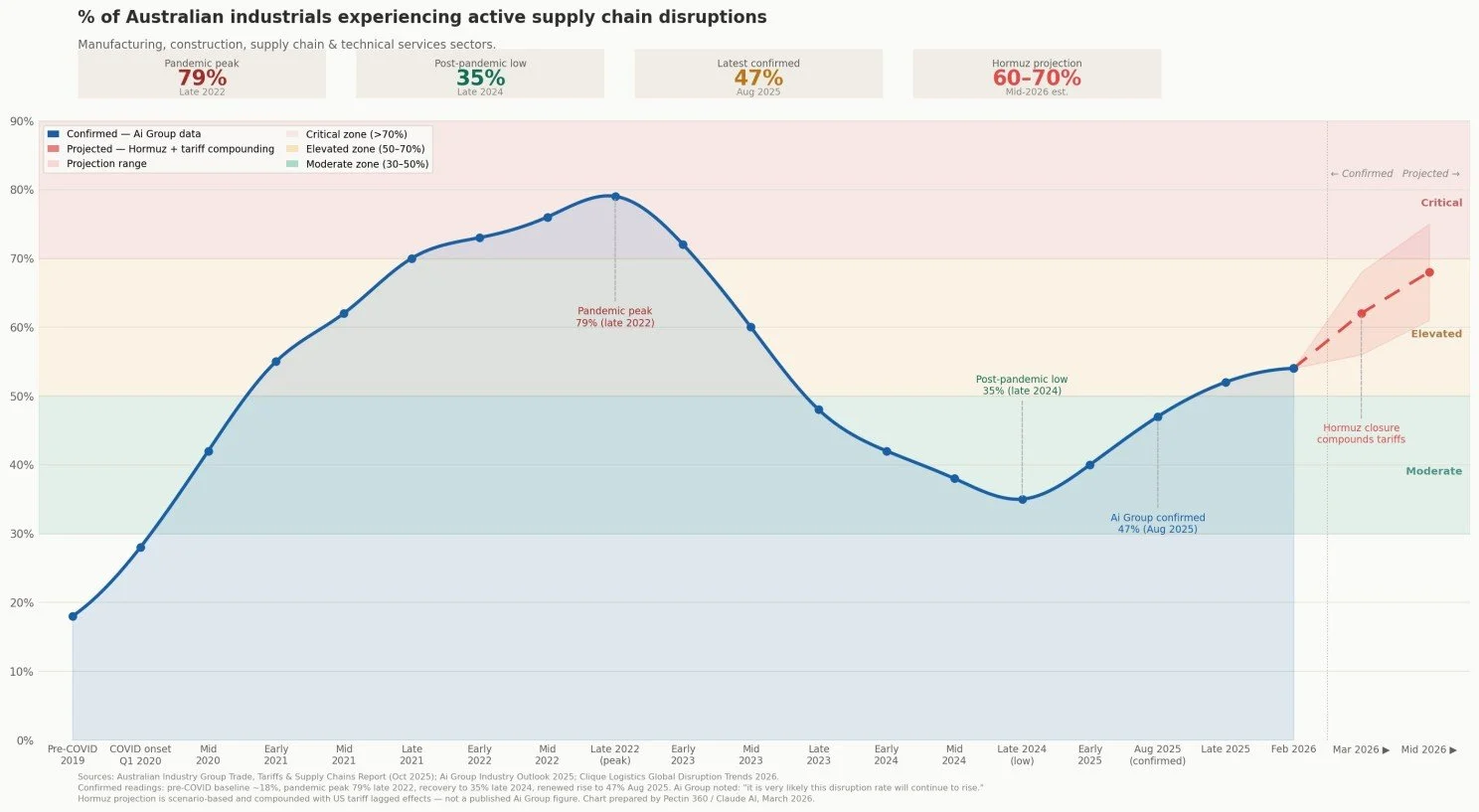
% of Australian industrials experiencing active supply chain disruptions.
But the case goes beyond security. Our biorefinery model retains value inside Australia - converting agricultural by-products that would otherwise be disposed of into commercially relevant inputs for the food industry. It supports the clean-label and sustainability credentials that are increasingly a commercial requirement, not a marketing preference. It strengthens the sovereign capability of Australia's food manufacturing base at exactly the moment that capability is being tested.
The Moment Is Now
Global supply chain volatility is not going to resolve cleanly. The dual chokepoint crisis in the Middle East, ongoing US tariff uncertainty, the structural Huanglongbing impact on citrus supply and the repricing of maritime insurance are not temporary conditions. They are the new operating environment.
The question for Australian food manufacturers is not whether to build more supply chain resilience - it is how quickly and with whom.
Pectin 360 is actively working with industry partners, food manufacturers and co-investors who see the same opportunity: a genuine, commercial-scale solution to an ingredient supply problem that is only going to intensify.